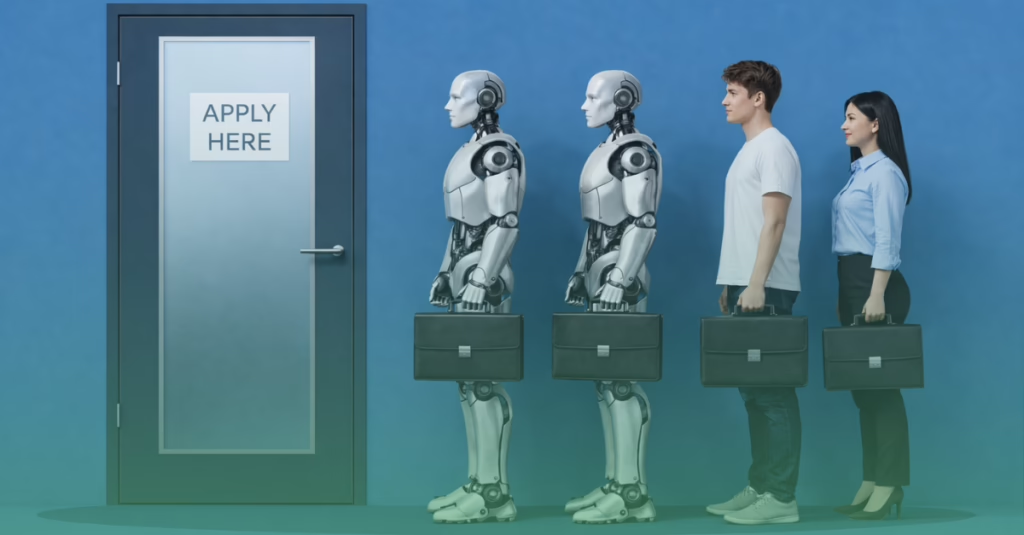
If you’re a young Aussie trying to crack the job market right now, it can feel a bit cooked.
Every second headline seems to be about AI replacing white-collar work, companies cutting grads, and employers saying they’d rather “hire AI than Gen Z”. At the same time, unemployment overall is still relatively low at 4.3% in February 2026, so it’s not that there are no jobs. It’s that the easy on-ramp into work is disappearing.
The recent reporting spells out a big part of the problem: AI is chewing up the repetitive tasks that used to justify entry-level roles, while bigger firms quietly cut junior positions and expect new hires to hit the ground running. But it also hints at the solution: if you learn to work with AI, choose your first roles strategically, and build skills faster than your peers, you can still get ahead.
This article digs into what’s actually happening in Australia and then gets very practical about how to stand out when entry-level jobs are shrinking.
What’s going on with entry-level jobs?
A few key trends are colliding at once.
Entry-level roles now make up just 11% of all vacancies, the lowest share in a decade, and down 37% since 2022. Meanwhile, the number of people stuck on JobSeeker for more than a year has climbed to nearly 600,000. That adds up to 39 people on JobSeeker for every single entry-level vacancy, the worst ratio Anglicare Australia has recorded in ten years of tracking it. Even if every one of those roles went to a long-term JobSeeker recipient, 96% would still miss out.
Companies are being refreshingly blunt about their plans. A survey of Australian companies by IDC, commissioned by Deel, found more than 93 per cent of firms plan to cut back on entry-level hires in the next one to five years as they roll out AI. Only 5 per cent still see a traditional degree as essential. What they care about now is practical skills like AI literacy and critical thinking.
Meanwhile, AI tools are already automating entry-level white-collar work in areas like law, consulting and media, according to ABC reporting this year. These are the sort of grunt tasks grads used to do to learn the ropes.
A Jobs and Skills Australia study reported that some employers have shifted recruitment toward hiring more senior and experienced workers because gen-AI tools and coding assistants mean they can get more done with a leaner, more senior team.
Young people are stuck in limbo longer as a result. The Foundation for Young Australians’ New Work Reality report showed that even before the latest AI wave, around half of 25-year-olds in Australia were unable to secure full-time work, despite most having post-school qualifications.
Zoom in on youth specifically and the picture gets even sharper. Recent analysis of the Australian labour market noted youth unemployment climbing to around 10.5 per cent, roughly double the headline rate, with underemployment also ticking up. In plain English: young people are much more likely to be stuck in casual or part-time gigs, or struggling to get that crucial first break.
So no, you’re not imagining it. The “just do a degree and you’ll be fine” promise is pretty much dead. But that doesn’t mean you’re doomed. It means you need to be more deliberate than previous generations about how you build skills and where you try to get in.
Why Gen Z cops it hardest
Gen Z happens to be entering the workforce right as AI becomes cheap, powerful and normal. That timing alone is rough. But there are a few extra reasons you’re feeling the squeeze.
AI is best at the stuff juniors used to do. Generating first drafts, summarising long documents, doing basic research, checking code, creating marketing copy: they’re exactly the tasks AI does frighteningly well. Employers are understandably asking whether they need as many juniors when the technology can handle so much of that workload.
Employers are nervous about “unprepared” grads. A Yahoo Finance survey reported that more than a third of employers globally would rather hire AI than a Gen Z graduate, in part because they feel many grads arrive without the practical skills or work habits they need.
Young workers and women are most exposed. An ADAPT report on Australia’s AI transition found that frontline and entry-level roles, especially those held by young people and women, are the most at risk from algorithmic workers and automation.
Put together, that’s a rough combo: fewer openings, tougher competition, and a perception gap about what Gen Z brings to the table. The good news is that perception is exactly where you can move the needle.
Make AI your unfair advantage
AI is not going away, so your best move is to treat it as a skill to master, not a monster to outrun. Industry leaders are encouraging young Aussies to see small-and-medium enterprises (SMEs) as “skills incubators” where you can learn fast, use AI on real problems, and build experience quickly.
Research by IDC and others backs this up: employers are increasingly willing to pay a premium for people who can actually use AI tools well, not just talk about them, while the value of a generic degree by itself is sliding.
So if you’re looking for a concrete way to stand out, here’s step one: make “AI-literate, fast learner” your brand.
That doesn’t mean you need to become a machine-learning engineer. It means you can confidently say and show: “I know how to use AI tools safely and productively for this job.”
Some practical ways to do that include learning how to use tools like ChatGPT, Claude or Copilot to draft, summarise, brainstorm and check your work. For any field you’re interested in, whether that’s marketing, HR, law, coding, design, or logistics, find tutorials on how people in that field are using AI and copy their workflows. Build a small portfolio that proves it: here’s a report I drafted with AI and then edited, here’s a simple automation I set up, here’s how I used AI to speed up research.
You want a hiring manager to look at your CV and think, “Okay, I won’t have to drag this person into the AI era. They’re already there.”
Learn from SMEs and not just big-name grad programs
Most young Aussies are funnelled to the same places: big four banks, large consulting firms, major government grad programs. Those are great if you can get in, but they’re also where AI-driven cuts and hiring freezes hit hardest. The IDC/Deel data and other reporting suggest larger firms are the ones most aggressively reducing entry-level roles as they automate.
By contrast, SMEs can be amazing “skills incubators”. In a small or mid-sized business, you’re more likely to wear multiple hats instead of doing one tiny slice of work, work directly with senior staff and decision-makers, and experiment with tools like AI and automation because the company is more nimble.
If you’ve only been applying to shiny grad schemes and ASX-listed giants, it’s worth widening your scope. Look for SMEs in growth industries like renewables, health tech, ag-tech, cyber, education tech, logistics, and community services. Don’t get hung up on the job title. Coordinator, assistant, analyst, support officer: all of these can be solid entry points if you’re learning and taking on real responsibility. Consider regional and outer-metro roles as well. Some of the toughest competition is in CBD-based, white-collar grad jobs. Going where fewer people look can massively improve your odds.
Entry-level positions may be declining, but entry-level experiences are everywhere if you’re willing to look beyond the obvious.
Build projects aside from qualifications
One thing employers keep saying in industry surveys and interviews is that a lot of grads look great on paper but can’t show how they actually apply their knowledge.
That’s fixable. The antidote is projects.
If you’re into marketing, run socials for a local café, charity or uni club. Track growth and learn some basic analytics. If you’re into tech, contribute to open-source projects, build a small app or website, or join a hackathon. For policy or research, volunteer with a local MP’s office, a community legal centre, or a non-profit that publishes submissions and reports. If you’re into design or media, build a portfolio of real client work, even if it’s low-paid or volunteer to start.
Employers don’t just want to know that you studied. They want proof you can deliver in messy, real-world conditions.
When you put these projects on your CV, spell out the problem (“Social media engagement was flat; they weren’t reaching local customers”), your actions (“Set up a basic content calendar, used Canva and AI tools to generate drafts, then refined with owner feedback”), and the outcome (“Engagement up 60 per cent in three months; followers doubled”).
That style of evidence hits way harder than listing five units you passed at uni.
Treat early work as a stepping stone instead of a life sentence
The FYA’s New Work Order series has been documenting for years how younger Australians will have more jobs, in more sectors, across a career than previous generations. The transition from education to stable full-time work is longer and more “squiggly”, with plenty of short contracts, part-time gigs and shifting roles along the way.
In a world where there are fewer classic entry-level jobs, it helps to reframe your mindset.
Your first proper role does not have to be in your dream industry. It just needs to grow skills you can take with you: customer communication, problem-solving, digital tools, teamwork. Short-term and contract roles are still valuable. If AI and automation are making employers cautious about permanent junior hires, you can still grab contract work and use it to prove yourself. Once you’re inside, you’re in a better position to jump when something permanent opens up. Side gigs count too. Freelancing, tutoring, gig-economy jobs with leadership components (like team leader roles), running a small online store: these can all be framed as real experience if you talk about them properly.
Your goal is not “land perfect job immediately”. It’s “stack enough real experience, quickly, that in 1–3 years I’m no longer competing for the tiny pool of entry-level roles”.
Make the hidden selection criteria obvious
Here’s the part no one writes in the job ad: employers aren’t only screening for skills. They’re screening hard for reliability and learning mindset, especially now that AI can already do a lot of the technical grunt work. IDC, Deel and Australian employers emphasise soft skills like communication, problem-solving and adaptability just as much as technical know-how.
To stand out, signal reliability everywhere. Turn up on time. Reply to emails properly. If you say you’ll send something by Friday, send it by Friday. Sounds basic, but managers repeatedly complain this is where some young applicants fall over.
Show you can learn fast by talking about a time you picked up a new tool or system quickly, especially if it was your idea. “I noticed we were doing X manually, so I taught myself Y and cut the time in half” is gold.
Show you’re coachable, not arrogant. There’s a stereotype that some Gen Z grads expect to run the place in six months. You can actively counter that by talking about times you took feedback on board and improved.
When you write your resume or walk into an interview, imagine the manager thinking: “If I hire you, will you make my life easier or harder?” Your job is to make it “easier” – blindingly obvious right.
Smart job-search tactics in a brutal entry-level market
If Anglicare’s numbers are right and 39 people are competing for each entry-level job, you can’t rely on just blasting out Seek applications. You need to work a bit smarter.
Stop sending generic applications. Tailor your CV and cover letter for each role. Use the job ad’s language, show two or three relevant projects, and explicitly mention any AI or digital tools they use.
Use warm introductions where you can. Ask tutors, past managers, friends and family if they know anyone in the industry. A 15-minute coffee chat can lead to a referral, which can bump your application to the top of the pile.
Flip the script with “problem-first” outreach. Instead of just asking “are you hiring?”, look at a small business or organisation, spot a real issue (out-of-date website, no social media, clunky processes), and send a short, polite note: “Here’s what I noticed, here’s what I could do in 4–6 weeks, here’s an example of similar work I’ve done.”
Be flexible on job titles and sectors. With overall unemployment still relatively low and many industries crying out for workers, you can often get into a sector you didn’t expect, pick up transferable skills, and pivot later.
This doesn’t mean you sell your soul to any random gig. It means you’re strategic: does this role grow skills I can use later, and can I explain that clearly to my future self (and future employers)?
Tell your story like someone worth taking a chance on
With AI in the mix, hiring managers are essentially choosing between a tool that’s fast, tireless and cheap (but can’t talk to customers or think ethically) and a human who brings judgment, creativity, relationships and initiative.
Your mission is to make that second option really attractive. You want your story to sound like: “I’m early in my career, but I learn quickly, I use AI and tech responsibly to do better work, and I’m a low-drama, high-effort person you won’t regret hiring.”
A few simple ways to shape that story include opening your CV with a 3–4 line summary focused on value, not vibes. Something like: “Early-career marketing generalist with hands-on experience running social campaigns for SMEs, using AI tools to create and test content, and working directly with owners to grow local customer reach.”
Add a small “Tools” section that explicitly includes AI tools you actually use. For each role or project, list 3–4 bullet points with actions and outcomes, not just duties.
In interviews, have two or three clear examples ready for learning something quickly, solving a problem with limited guidance, and working well with others (even when things were stressful).
You’re not trying to pretend you’re a seasoned pro. You’re trying to make it really obvious that you’re a smart bet for an entry-level hire in a world where entry-level seats are scarce.
Final: The ladder hasn’t disappeared, it’s changing
It’s absolutely fair to be frustrated. Older generations did not have to compete with AI models for their first job, and they had more traditional entry-level pathways to climb.
But the ladder hasn’t vanished. It’s just more crooked, and the bottom few rungs are narrower. Reports from Anglicare, FYA, Jobs and Skills Australia and others all point to the same reality: young Australians face a tougher, longer transition into stable work, but those who stack experience early, stay adaptable and lean into technology (not away from it) still find their footing.
You don’t have to magically fix the job market. You just have to tilt the odds in your favour: get fluent with AI instead of fearing it, chase learning-rich roles (especially in SMEs), build real projects, and tell your story like someone worth betting on.
That combination is how you stand out, even when entry-level roles are in short supply.